Who Makes McDonald’s Self-Ordering Kiosks?
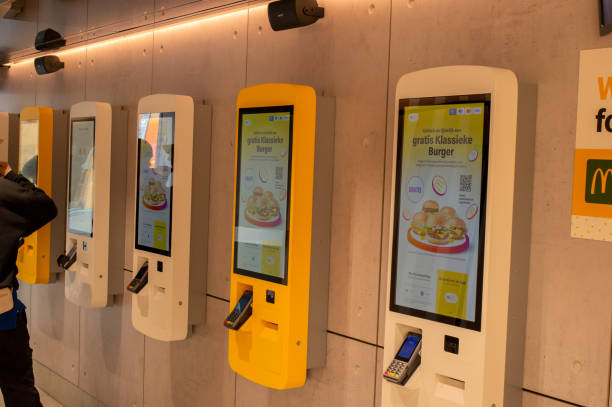
Walk into almost any McDonald’s today, and you are greeted by a towering, sleek slab of glass. These self-ordering kiosks have fundamentally changed the Quick Service Restaurant, or QSR, industry.
For those of us in the manufacturing industry, these screens represent more than a menu; they are a sophisticated piece of industrial engineering. This prompts a specific question: Who actually manufactures McDonald’s self-ordering kiosks?
As a touchscreen monitor manufacturer, I’ve analyzed the components inside these self-ordering kiosks. It is a complex ecosystem of hardware vendors and software architects. Let’s dig into the supply chain, the tech specs, and the economics behind this digital revolution.
Major Hardware Manufacturers Behind the Kiosks
Searching for a generic brand sticker on the back of a McDonald’s machine usually reveals nothing. McDonald’s does not buy off-the-shelf computers; they partner with specialized solution integrators who understand the nuances of QSR operations.
The Primary Manufacturer: Acrelec
The dominant name in this space is Acrelec. Based in France but operating globally, Acrelec manufactures the vast majority of the kiosk enclosures and handles the hardware integration for McDonald’s locations, with over 80,000 installations across 80 countries.
Why does McDonald’s choose Acrelec? The choice goes beyond simple hardware durability. Acrelec was founded by former McDonald’s veterans, Jacques Mangeot and Jalel Souissi. This background gives them a unique insight: they understand the restaurant’s operational flow from the inside out, allowing them to design solutions that align precisely with McDonald’s strict standards and in-store workflows.
Their competitive edge lies in three key areas:
- Operational DNA: Unlike generalist enclosure manufacturers, Acrelec designs kiosks that integrate seamlessly with the kitchen’s throughput. Their hardware focuses on ergonomic efficiency and speed of service, ensuring the technology accelerates rather than bottlenecks the ordering process.
- End-to-End Scalability: McDonald’s requires a partner capable of standardized global rollout. Acrelec provides a consistent “Phygital” experience by blending physical and digital interactions. This ensures brand consistency whether the kiosk is deployed in Paris, New York, or Tokyo.
- Modular Lifecycle Management: Acrelec units feature a highly modular architecture. This allows operators to upgrade specific components, such as payment terminals or scanners, without replacing the entire enclosure. This modularity drastically reduces the Total Cost of Ownership (TCO) over the machine’s 5-to-7-year lifespan.
Other Hardware Integrators
While Acrelec is the primary global partner, McDonald’s employs a multi-vendor strategy to serve specific regional markets:
- Pyramid Computer: Dominant in the European market, specifically Germany, Pyramid is known for its “Polytouch” series. This line offers high customizability and sleek aesthetic integration.
- Coates Group: A major player in digital merchandising, particularly active in Australian and Asian markets. Their focus lies in integrating the kiosk into the store’s broader digital signage ecosystem.
Regardless of the specific integrator, the core component defining the user experience is the Projected Capacitive (PCAP) Touchscreen. This industrial-grade technology is no longer exclusive to global franchises. At Touchwo, we manufacture our hardware to the exact same benchmarks found in these top-tier deployments.
For instance, our 27-inch Wall Mounting Touch Kiosk, Model GD27C, is engineered with Mohs Class 7 explosion-proof glass. This allows it to withstand the physical impacts and scratch risks common in high-traffic QSR environments. Furthermore, we integrate high-luminosity 500–700 nits panels and essential peripherals, such as printers and scanners, into a 13mm ultra-slim bezel. This design ensures businesses can access the same operational durability and modularity as a McDonald’s franchise, without the need for a proprietary contract.